
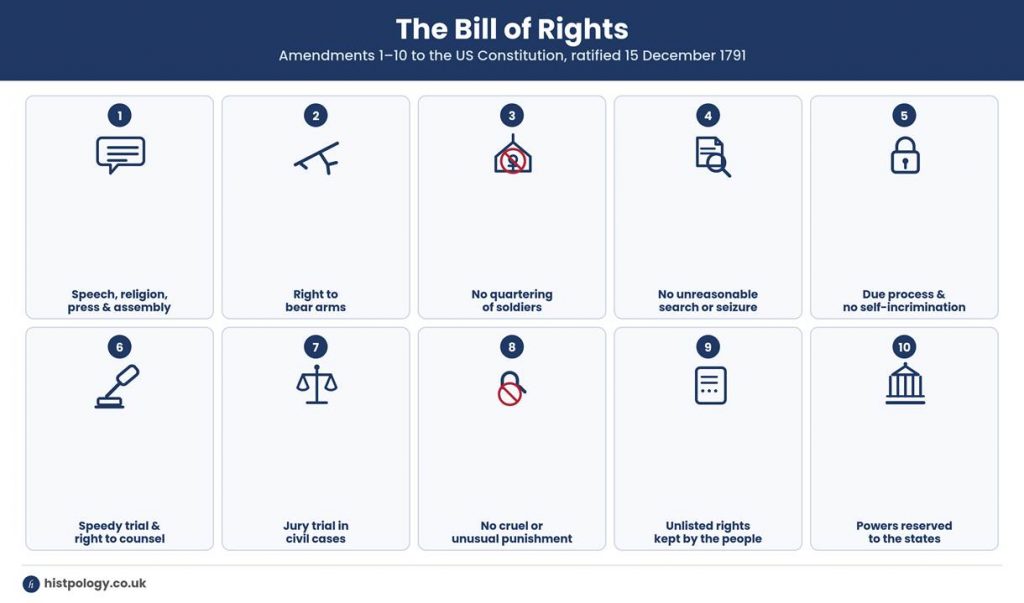
Figure 1: the ten amendments of the Bill of Rights, illustrated.
Article V of the Constitution sets out how it can be amended. An amendment must first be proposed, either by a two-thirds vote in both the House of Representatives and the Senate, or by a national convention called at the request of two-thirds of state legislatures, a method never yet used. It must then be ratified by three-quarters of the states, either through their legislatures or, in one case, through state ratifying conventions. This deliberately high bar means only 27 amendments have been ratified since 1788, out of thousands proposed.
The table below sets out a selection of the most significant amendments: what each one does, how it was passed, and an evaluation of its lasting significance. The first ten amendments are grouped together as the Bill of Rights, and the Thirteenth to Fifteenth Amendments are grouped as the Reconstruction Amendments, since these are best understood as sets rather than in isolation.
Summary at a glance
- Bill of Rights (1791): guarantees core civil liberties, such as free speech, a fair trial and protection from unreasonable search, against the federal government.
- Reconstruction Amendments (1865-1870): abolished slavery, guaranteed citizenship and equal protection, and banned racial discrimination in voting, following the Civil War.
- Sixteenth Amendment (1913): gave Congress the power to levy a federal income tax.
- Eighteenth and Twenty-first Amendments (1919 and 1933): introduced, then fully repealed, the nationwide prohibition of alcohol.
- Nineteenth Amendment (1920): gave women the right to vote.
- Twenty-second Amendment (1951): limited presidents to two elected terms in office.
- Twenty-fifth Amendment (1967): set out clear procedures for presidential succession and disability.
| Amendment | What it does | How it was passed | Evaluation of significance |
| Bill of Rights (Amendments 1-10, 1791) | Ratified together, the first ten amendments are known collectively as the Bill of Rights. They protect core civil liberties against the federal government, including freedom of speech, religion, the press, assembly and petition (First Amendment) and the right to bear arms (Second Amendment). Others protect legal rights: freedom from unreasonable searches (Fourth Amendment), due process and protection against self-incrimination and double jeopardy, being tried twice for the same offence (Fifth Amendment), the right to a fair trial and legal counsel, a lawyer (Sixth Amendment), and protection from cruel and unusual punishment (Eighth Amendment). The Ninth Amendment and Tenth Amendment confirm that rights not listed still belong to the people, and that powers not given to the federal government remain with the states. | Proposed by Congress in September 1789 as a package of twelve amendments, two of which were not ratified at the time, and ratified together on 15 December 1791, when Virginia became the eleventh state to approve them. | The Bill of Rights is foundational to American civil liberties, but its meaning owes as much to later case law as to its original text. Rulings such as Mapp v Ohio (1961), Gideon v Wainwright (1963), Brandenburg v Ohio (1969) and District of Columbia v Heller (2008) show these amendments still generate significant legal and political argument. It is also worth noting that these protections originally bound only the federal government. They were extended to the states gradually through a process known as incorporation, mainly using the Fourteenth Amendment‘s due process clause. |
| Reconstruction Amendments: Thirteenth to Fifteenth (1865-1870) | These three amendments, often called the Reconstruction Amendments, followed the Union’s victory in the American Civil War (1861-1865). The Thirteenth Amendment abolishes slavery and involuntary servitude, except as punishment for a crime. The Fourteenth Amendment grants citizenship to all persons born in the United States and guarantees equal protection of the law and due process to all citizens. The Fifteenth Amendment prohibits denying the right to vote on the basis of race, colour, or previous condition of servitude, meaning enslavement. | The Thirteenth Amendment was proposed in January 1865 and ratified in December 1865, immediately after the Civil War ended. The Fourteenth Amendment was proposed in 1866 and ratified in 1868, and the Fifteenth was proposed in 1869 and ratified in 1870. Congress required former Confederate states to ratify the Fourteenth Amendment as a condition of re-admission to the Union, giving these amendments an unusually coercive path to ratification. | These amendments were a direct constitutional consequence of the Civil War. They entrenched abolition and citizenship in the Constitution itself, making the Union’s victory permanent rather than dependent on ordinary legislation that a later Congress could repeal. In practice, however, their significance was delayed by decades: Southern states used poll taxes, literacy tests and violence to deny Black Americans the vote and equal treatment until the civil rights movement and the Voting Rights Act 1965. This shows that formal constitutional change did not, by itself, guarantee real political or social change. |
| Sixteenth Amendment (1913) | Gives Congress the power to levy an income tax without apportioning it among the states by population. | Proposed on 12 July 1909 and ratified on 3 February 1913, reversing the Supreme Court’s ruling in Pollock v Farmers’ Loan & Trust Co (1895), which had struck down an earlier federal income tax. | Transformed the size and reach of the federal government by giving it a reliable, elastic source of revenue. It made possible the expansion of federal programmes across the twentieth century, from the New Deal to modern welfare spending, and so significantly altered the balance of federalism between Washington and the states. |
| Eighteenth and Twenty-first Amendments (1919 and 1933) | The Eighteenth Amendment prohibited the manufacture, sale and transportation of alcoholic beverages within the United States. The Twenty-first Amendment repealed it in full, ending prohibition. | The Eighteenth Amendment was proposed on 18 December 1917 and ratified on 16 January 1919. The Twenty-first Amendment was proposed on 20 February 1933 and ratified on 5 December 1933, becoming the only amendment ratified by state conventions rather than state legislatures. | Prohibition is widely judged a policy failure. It fuelled organised crime and widespread law-breaking rather than eliminating alcohol consumption. The Eighteenth Amendment remains the only amendment ever repealed in full, and its repeal shows that the amendment process, though difficult, is not irreversible. Together, the two amendments are a useful case study in the limits of using the Constitution to enforce social morality. |
| Nineteenth Amendment (1920) | Prohibits denying the right to vote on the basis of sex, extending the vote to women in federal and state elections. | Proposed by Congress on 4 June 1919 and ratified on 18 August 1920, when Tennessee became the 36th state to approve it. | The amendment was the culmination of a suffrage campaign stretching back to the Seneca Falls Convention of 1848. It significantly expanded the electorate, but its benefits were not shared equally. Many Black women, particularly in the South, remained effectively disenfranchised by the same poll taxes and literacy tests used against Black men under the Fifteenth Amendment, until the Voting Rights Act 1965. |
| Twenty-second Amendment (1951) | Limits presidents to two elected terms in office. | Proposed on 21 March 1947, following Franklin D. Roosevelt’s four elected terms, and ratified on 27 February 1951. | Converts a previously informal norm, established by George Washington’s voluntary retirement after two terms, into binding law. It remains politically salient, with periodic, so far unsuccessful, proposals to repeal it in relation to popular presidents. |
| Twenty-fifth Amendment (1967) | Sets out procedures for presidential succession and for declaring a president unable to discharge the duties of office. | Proposed on 6 July 1965, prompted by the constitutional uncertainty following President Kennedy’s assassination in 1963, and ratified on 10 February 1967. | Provided clarity previously absent from Article II. Its Section 4, which allows the vice president and cabinet to remove an incapacitated president, has attracted renewed attention amid debate over presidential fitness for office, though it has never actually been invoked for that purpose. |
Table note: dates given are ratification dates unless stated otherwise. Case citations are given in short form (party names and year); full citations can be found via the sources below.